Cystoscopy

 03-3874-8184
Cystoscopy
If you have blood in your urine, persistent urinary symptoms, recurrent urinary tract infections, or other symptoms that require a closer look inside the bladder, cystoscopy may be recommended.
At our urology clinic in Asakusa, Tokyo, flexible cystoscopy is performed by board-certified urologists. The examination is performed as an outpatient procedure, so you can return home on the same day. English support is available throughout the examination, with translation devices used when needed.
If you are visiting Tokyo and need a specialist urological examination during your stay, we can assess your symptoms and determine whether cystoscopy is appropriate for you.
Cystoscopy is a procedure that allows a urologist to directly examine the inside of the urethra and bladder using a thin, flexible instrument with a small camera.
Unlike an ultrasound or CT scan, cystoscopy allows the doctor to directly see the lining of the bladder and urethra.
A flexible cystoscope is inserted gently through the urethra into the bladder. Local anesthetic gel is used to make the procedure as comfortable as possible.
The examination itself usually takes only a few minutes.
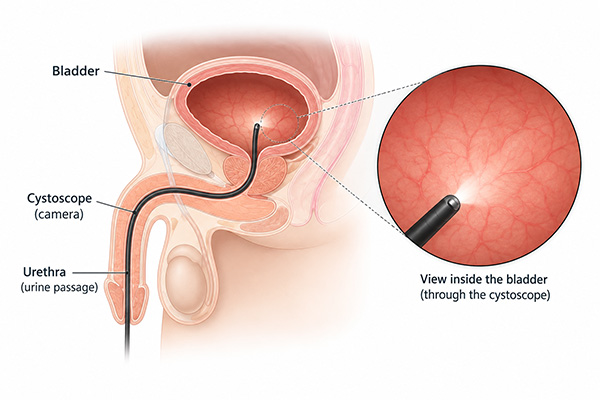
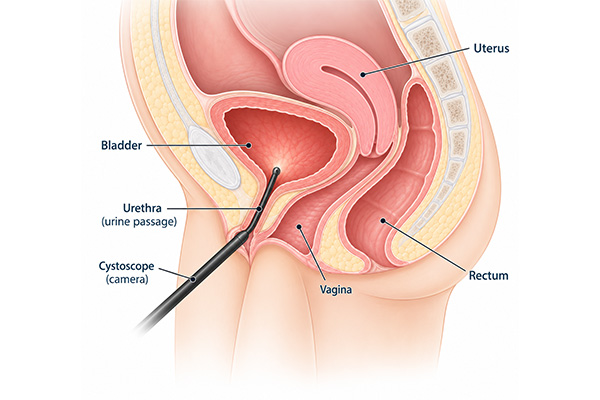
Illustrations of flexible cystoscopy in male and female patients.
Cystoscopy is not necessary for everyone with urinary symptoms. Your doctor may recommend cystoscopy when a direct examination of the bladder or urethra is needed to determine the cause of your symptoms.
Your urologist will determine whether cystoscopy is appropriate based on your symptoms, urine test results, medical history, and other examination findings.
Cystoscopy allows the urologist to directly examine the lining of the bladder and urethra.
If a suspicious lesion is found during cystoscopy, a biopsy may be recommended to determine whether further evaluation is necessary. We do not perform bladder biopsies at our clinic. If a biopsy is considered necessary, we may refer you to an appropriate hospital or specialist medical institution for further evaluation and treatment.
Before the examination, your doctor will explain why cystoscopy is being recommended and answer any questions you may have.
You will lie on an examination table, and the area around the urethral opening will be cleaned.
A local anesthetic gel will then be applied to the urethra.
The flexible cystoscope is gently inserted through the urethra and advanced into the bladder. The bladder is filled with normal saline to allow the doctor to examine the bladder lining clearly.
You may feel some pressure, discomfort, or an urge to urinate during the examination. Most patients can tolerate the procedure without major difficulty.
Cystoscopy may cause some discomfort, but flexible cystoscopy is generally well tolerated.
Local anesthetic gel is used to reduce discomfort during insertion of the cystoscope.
You may feel pressure or a temporary urge to urinate while the bladder is being examined.
If you are concerned about pain or discomfort, please let us know before the procedure.
If you are visiting Tokyo and need a urological examination, you may not have the option of waiting several weeks or months for an appointment.
At our clinic, cystoscopy can be performed on an outpatient basis when medically appropriate. We assess your symptoms and perform the necessary examinations based on your individual situation. If cystoscopy is considered appropriate, it may be performed during the same visit, depending on the clinical circumstances and availability.
This can be particularly helpful for international visitors who need a specialist urological evaluation during their stay in Japan.
After the examination, you can usually return home on the same day.
You may experience mild discomfort when urinating, a frequent urge to urinate, or a small amount of blood in your urine for a short time. These symptoms usually improve within a few days.
At our clinic, antibiotics are prescribed after cystoscopy to reduce the risk of urinary tract infection. Please take the prescribed medication exactly as instructed and complete the prescribed course unless your doctor tells you otherwise.
If you are traveling, we recommend allowing yourself some time to rest after the examination and staying well hydrated.
If you develop a fever, severe or worsening pain when urinating, significant bleeding, difficulty passing urine, or other concerning symptoms after the procedure, please contact a medical institution promptly.
In most cases, your doctor can explain the findings immediately after the examination.
If an abnormality is found, your doctor will explain what it means and discuss whether additional testing, treatment, or referral to a hospital is necessary.
English support is available on all clinic days, including for cystoscopy and other urological examinations.
Our reception staff and nurses generally use translation devices to assist communication when needed.
An English-speaking doctor is available every Wednesday from 10:00 AM for patients who prefer more detailed communication in English. English-supported consultations
and examinations are also available on other days with the assistance of translation devices.
Flexible cystoscopy is performed by board-certified urologists.
Cystoscopy is performed on an outpatient basis, so you can return home after the examination.
Your doctor will explain the findings after the examination.
Convenient for international visitors staying in Tokyo.
If you have urinary symptoms or an abnormal finding that requires further evaluation, please make an appointment with our urology clinic.
You do not need to decide in advance whether you need cystoscopy. Our urologists will evaluate your symptoms and examination results and determine whether cystoscopy is appropriate.
TOPに
戻る
 WEB予約